

For collision repairers, the question is no longer simply, “What does this part cost?”
Increasingly, the bigger question is: Can this vehicle still be repaired economically?
That distinction matters.
Collision repair costs continue to face pressure from vehicle complexity, labor, diagnostics, calibrations, parts pricing and an increasingly unpredictable global supply chain. At the same time, tariffs and changing trade policies are adding another variable to the cost and availability of automotive parts.
The result is a collision repair environment where every sourcing decision can carry more weight — particularly for vehicles already approaching the line between repairable and total loss.
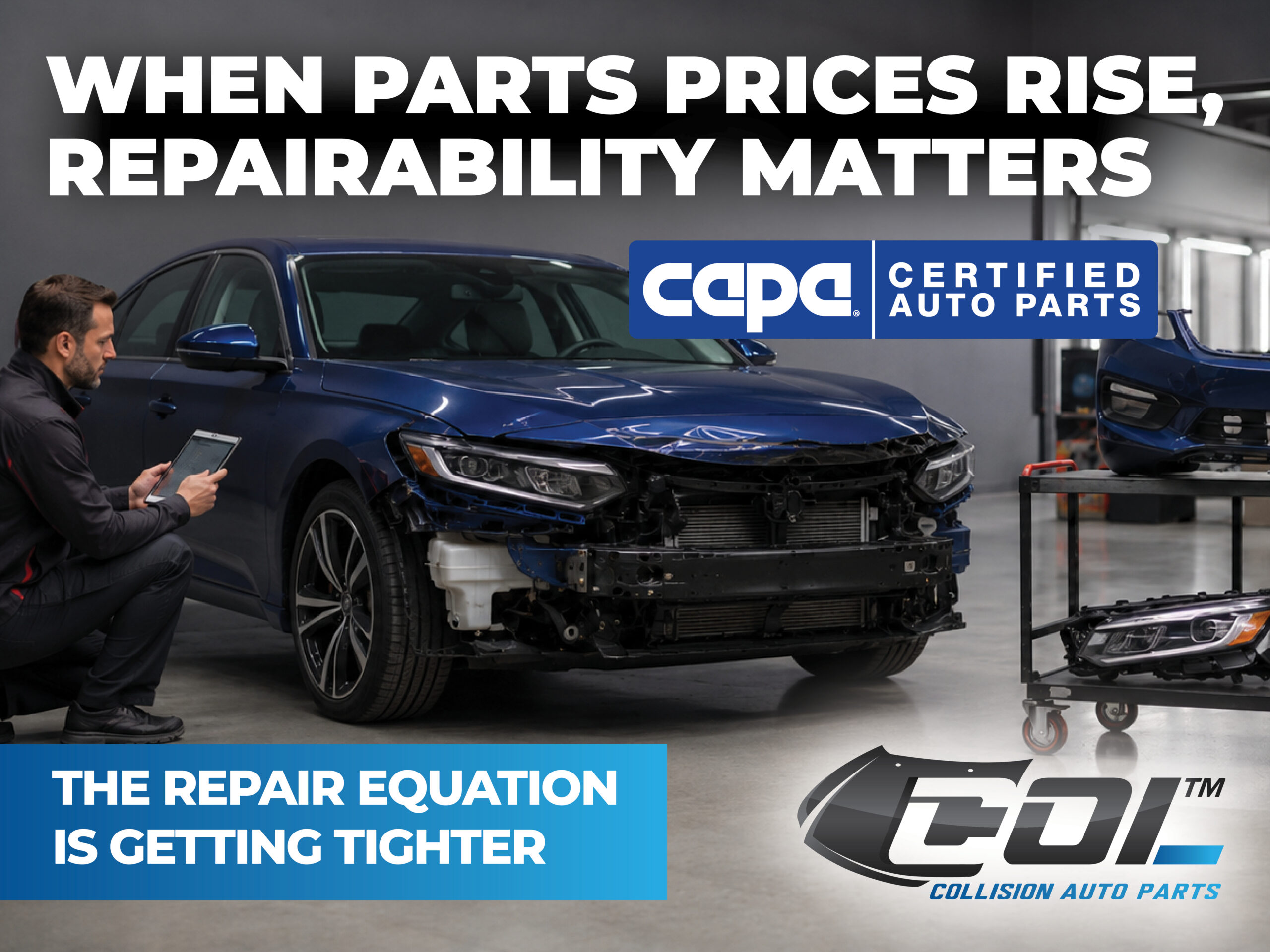
The Repair Equation Is Getting Tighter
The broader cost of maintaining and repairing vehicles continues to rise. U.S. Bureau of Labor Statistics data for July 2026 showed motor vehicle maintenance and repair costs 6.6% higher than a year earlier, while motor vehicle repair specifically was up 6.2%. Vehicle parts and equipment other than tires were also up 6.6% year over year.
Collision repair has its own additional pressures.
Modern vehicles contain more sensors, electronics, cameras and advanced driver assistance systems than previous generations. Components that were once relatively straightforward to replace may now involve scanning, diagnostics, specialized mounting requirements and calibration procedures.
CCC Intelligent Solutions reported that 28.3% of repairable estimates now include calibrations, reflecting just how much vehicle technology has become part of the collision repair process.
Add higher parts costs to that equation and seemingly modest increases can become important.
More Vehicles Are Reaching the Total-Loss Line
CCC’s 2026 Crash Course report found that the share of claims classified as total losses reached 23.1% across all loss categories in 2025 — an industry high. CCC points to older vehicles, increasing repair costs and changing claim behavior as factors affecting the economics of repair versus replacement.
The average total cost of repair also continued to rise, reaching a preliminary $4,818 in 2025. While the 1.7% year-over-year increase was relatively modest compared with recent years, CCC noted that higher parts dollars and miscellaneous costs such as diagnostics remained important contributors.
That creates an important consideration for collision repairers and insurers.
On a vehicle comfortably below its total-loss threshold, a change in parts cost may have relatively little effect on the overall repair decision.
On a borderline vehicle, it can be a different story.
A few hundred dollars across several replacement components, additional procedures or an extended parts delay can materially change the repair economics.
That is where parts choice becomes especially important.
Alternative Parts Are Becoming a Bigger Part of the Conversation
The industry already appears to be responding.
Mitchell reported in March that utilization of aftermarket, recycled and remanufactured parts had increased by approximately 1.5 percentage points year over year in the United States. Mitchell connected some of that increased interest to tariff-related price pressure while also noting that aftermarket inventory has returned to more normalized, pre-pandemic levels.
CCC’s data shows a similar shift. In 2025, aftermarket parts represented a larger share of replacement part dollars while OEM part dollars declined.
That does not mean the lowest-priced part should automatically win.
Proper repair procedures, fit, quality and safety remain the priorities. Certain applications may require specific components or procedures, and vehicle technology can limit the choices available.
But when multiple appropriate repair options exist, access to quality alternative parts can give estimators, repairers and insurers another tool for controlling severity without automatically sacrificing the repair.
CAPA-Certified Parts Add a Quality Benchmark
For shops considering aftermarket parts, certification can help separate price alone from verified quality. Collision Auto Parts stocks both CAPA-certified and non-certified aftermarket parts, giving repairers options based on the requirements of the estimate, insurer program and shop standard operating procedures.
The Certified Automotive Parts Association (CAPA) is an independent, nonprofit organization that develops quality standards and certifies qualifying replacement crash parts. Before a part can carry the CAPA Quality Seal, the manufacturer facility must be approved and the individual part must pass testing against the applicable CAPA standard.
Depending on the part category, that evaluation can include material properties, dimensions, coating performance, weld or adhesive integrity, corrosion resistance, lighting or electronic performance, and vehicle test fit. CAPA also conducts ongoing random inspections of participating factories and certified parts to verify that standards continue to be met.
For collision professionals, that makes CAPA certification a practical sourcing benchmark. When a CAPA-certified option is appropriate for the repair, it can combine the cost and availability advantages of the aftermarket with an independent quality-assurance process.
Tariffs Make Sourcing Flexibility Even More Valuable
Parts pricing is unlikely to become simpler anytime soon.
Automakers continue to navigate tariffs affecting automotive parts, steel, aluminum and cross-border vehicle production. As of August 2026, major U.S. automakers are still reporting significant tariff-related cost pressure while additional North American trade changes remain under discussion.
Mitchell has also reported tariff-related price increases beginning to appear in OEM replacement parts, contributing to increased industry interest in alternative sourcing.
For collision centers, the lesson may be less about predicting where tariffs go next and more about maintaining options.
A sourcing strategy built around multiple qualified channels can provide greater flexibility when prices shift, inventories tighten or a particular replacement component suddenly becomes difficult to obtain.
Availability Is Part of the Cost Equation, Too
Price is only one measure of a part’s true cost to a repair.
If a vehicle occupies a production space while a shop waits for a component, the effects can extend into cycle time, rental days, scheduling and overall throughput.
That makes local and regional parts availability increasingly valuable.
Mitchell’s 2026 collision analysis recommends that repairers and carriers maintain strategic relationships across OEM, aftermarket, recycled and remanufactured suppliers and use flexible sourcing strategies when replacement is required.
In other words, the right part is not simply one with the right price. It is the right quality part, for the right application, available when the repair needs it.
Keeping More Repair Options on the Table
The collision industry cannot control inflation, international trade policy or the increasing complexity built into today’s vehicles.
It can control how effectively it responds.
That means evaluating each repair carefully. It means understanding when repair versus replacement is appropriate. And when replacement is required, it means having access to competitive, quality parts options that can help keep the overall repair economically viable.
Collision Auto Parts supplies collision repair facilities throughout California, New Mexico and surrounding markets with certified and non-certified aftermarket replacement components, including CAPA-certified options, bumper covers, hoods, fenders, grilles, lamps, cooling components and more.
As repair costs continue to evolve, that access becomes about more than saving money on an individual component.
It is about giving collision professionals more ways to build a safe, efficient and economically sound repair.
And when the line between repairable and total loss keeps getting tighter, every good option matters.